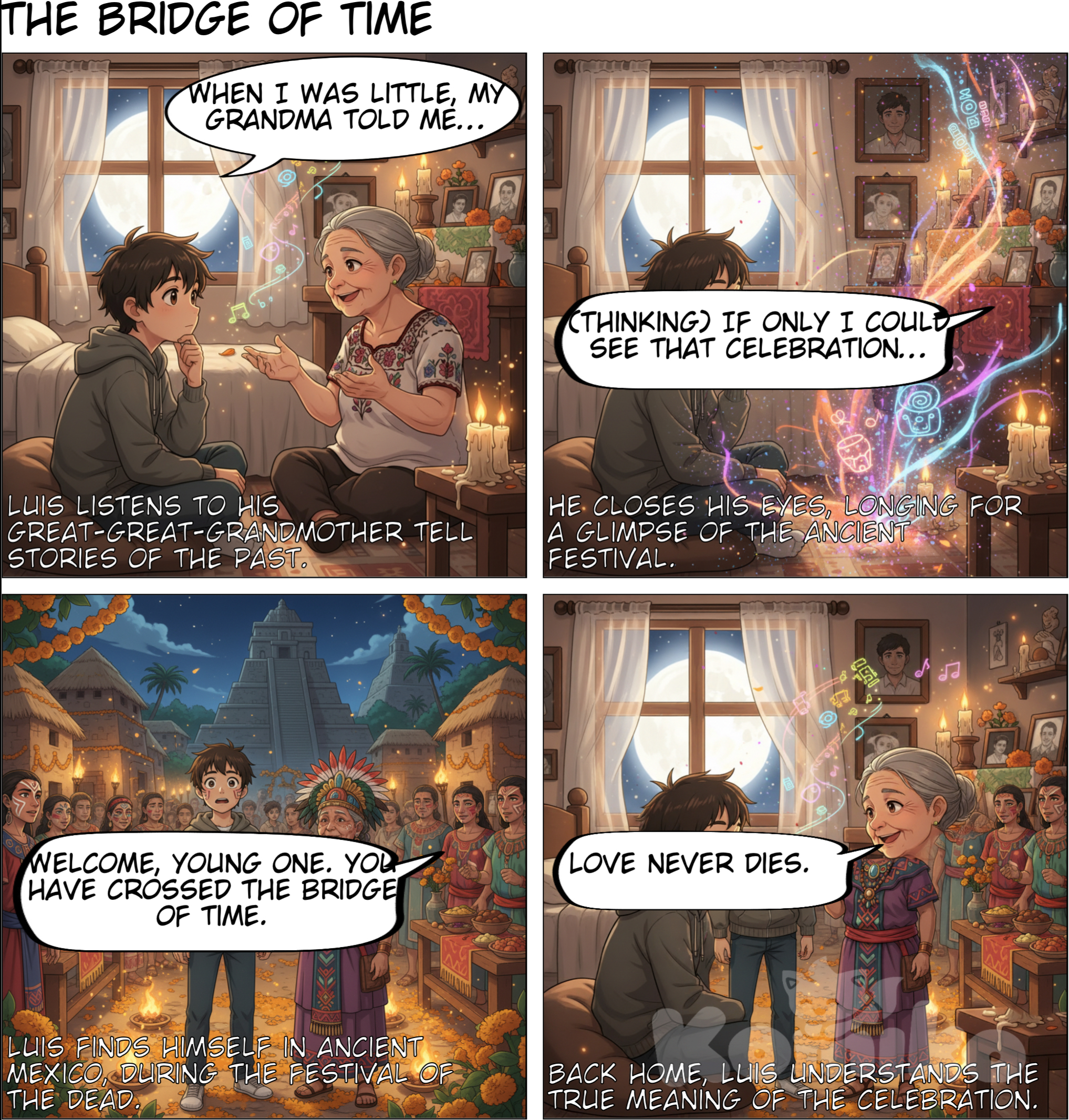
AI Art: Scene 1 – The Present: A Story Begins (Luis, a 16-year-old boy, is in his room watching his great-great-grandmother, Doña Carmen, tell a story.) Doña Carmen: When I was a little girl, my grandmother told me that long ago, people celebrated death not with fear, but with love. Luis: Really? That sounds strange… people celebrating death? Doña Carmen (smiling): Yes, mi niño. It was called El Día de los Muertos. People believed their loved ones came back for one night. They brought food, candles, and flowers to guide their souls home. Narration (Present Simple): I love listening to her stories. She always speaks with passion, like she lived in another world. ⸻ Scene 2 – The Mysterious Night (Luis is lying in bed, looking at the moon through the window.) Luis (thinking): If only I could see that celebration… Narration (Present Continuous): The wind is blowing softly, and candles on my altar are flickering. I am closing my eyes… (Suddenly, light fills the room. The sound of drums and flutes begins to echo.) Narration (Past Continuous): The air was glowing with colors. The scent of marigolds was filling the room. Something magical was happening. ⸻ Scene 3 – The Ancient World (Luis opens his eyes. He is standing in an old Aztec village surrounded by people wearing colorful clothes and face paint.) Luis: Where am I? Elder Woman: Welcome, young one. You have crossed the bridge of time. You are in the old land of Mexico, during Miccailhuitontli — the festival of the dead. Narration (Past Simple): I couldn’t believe it. I was really in the past — in ancient Mexico! (Luis walks around and sees people preparing offerings.) Elder Woman: We honor our ancestors so their spirits don’t forget us. Death is not the end, it’s a part of life. ⸻ Scene 4 – The Celebration (Luis watches people singing and dancing. The night sky glows with thousands of candles.) Narration (Past Continuous): Children were laughing, women were cooking tamales, and men were playing drums made of wood and skin. Luis (to himself): They aren’t afraid. They are celebrating with love. Elder Woman: Yes, because our loved ones never leave. They live in our hearts and return every year to visit us. Narration: I start to feel tears in my eyes. I understand now — this is not a day of death, but a day of memory and love. ⸻ Scene 5 – The Meaning of the Tradition (Luis and the woman walk to an altar full of food, candles, and skulls made of sugar.) Luis: Why do you use these skulls? Elder Woman: The skull reminds us that death is part of life. Each one is sweet — just like the memories we keep. Narration (Past Continuous): Families were talking about their ancestors, telling stories, and thanking them for everything they gave. (Luis touches one of the marigolds. It glows brightly.) Elder Woman (softly): The flower you touch will guide you back home, young traveler. ⸻ Scene 6 – Back to the Present (Luis wakes up in his room, holding a marigold petal in his hand.) Narration (Past Simple): When I opened my eyes, the music was gone. The candles were cold. But the flower was still there. Luis (smiling): Now I understand, great-great-grandma. The Day of the Dead is not about saying goodbye — it’s about remembering forever. Narration (Present Simple): Today, I am preparing an altar with my family. I put photos, candles, and my dog’s picture too. Because love never dies. (The last image shows Luis smiling at the altar, surrounded by the glow of candles, and faintly, the spirits of his ancestors smiling behind him.)
Created by bouncy sunflower
Content Details
Media Information
User Interaction
About this AI Creation
Description
Creation Prompt
Engagement

bouncy sunflower
bouncy sunflower
Scene 1 – The Present: A Story Begins (Luis, a 16-year-old boy, is in his room watching his great-great-grandmother, Doña Carmen, tell a story.) Doña Carmen: When I was a little girl, my grandmother told me that long ago, people celebrated death not with fear, but with love. Luis: Really? That sounds strange… people celebrating death? Doña Carmen (smiling): Yes, mi niño. It was called El Día de los Muertos. People believed their loved ones came back for one night. They brought food, candles, and flowers to guide their souls home. Narration (Present Simple): I love listening to her stories. She always speaks with passion, like she lived in another world. ⸻ Scene 2 – The Mysterious Night (Luis is lying in bed, looking at the moon through the window.) Luis (thinking): If only I could see that celebration… Narration (Present Continuous): The wind is blowing softly, and candles on my altar are flickering. I am closing my eyes… (Suddenly, light fills the room. The sound of drums and flutes begins to echo.) Narration (Past Continuous): The air was glowing with colors. The scent of marigolds was filling the room. Something magical was happening. ⸻ Scene 3 – The Ancient World (Luis opens his eyes. He is standing in an old Aztec village surrounded by people wearing colorful clothes and face paint.) Luis: Where am I? Elder Woman: Welcome, young one. You have crossed the bridge of time. You are in the old land of Mexico, during Miccailhuitontli — the festival of the dead. Narration (Past Simple): I couldn’t believe it. I was really in the past — in ancient Mexico! (Luis walks around and sees people preparing offerings.) Elder Woman: We honor our ancestors so their spirits don’t forget us. Death is not the end, it’s a part of life. ⸻ Scene 4 – The Celebration (Luis watches people singing and dancing. The night sky glows with thousands of candles.) Narration (Past Continuous): Children were laughing, women were cooking tamales, and men were playing drums made of wood and skin. Luis (to himself): They aren’t afraid. They are celebrating with love. Elder Woman: Yes, because our loved ones never leave. They live in our hearts and return every year to visit us. Narration: I start to feel tears in my eyes. I understand now — this is not a day of death, but a day of memory and love. ⸻ Scene 5 – The Meaning of the Tradition (Luis and the woman walk to an altar full of food, candles, and skulls made of sugar.) Luis: Why do you use these skulls? Elder Woman: The skull reminds us that death is part of life. Each one is sweet — just like the memories we keep. Narration (Past Continuous): Families were talking about their ancestors, telling stories, and thanking them for everything they gave. (Luis touches one of the marigolds. It glows brightly.) Elder Woman (softly): The flower you touch will guide you back home, young traveler. ⸻ Scene 6 – Back to the Present (Luis wakes up in his room, holding a marigold petal in his hand.) Narration (Past Simple): When I opened my eyes, the music was gone. The candles were cold. But the flower was still there. Luis (smiling): Now I understand, great-great-grandma. The Day of the Dead is not about saying goodbye — it’s about remembering forever. Narration (Present Simple): Today, I am preparing an altar with my family. I put photos, candles, and my dog’s picture too. Because love never dies. (The last image shows Luis smiling at the altar, surrounded by the glow of candles, and faintly, the spirits of his ancestors smiling behind him.)
3 months ago